- 市場動向
Tokyo Housing Price Forecast 2026: Is Tokyo Real Estate Still a Good Investment?
Last Updated: 10月 23, 2026
Tokyo housing forecast for 2026: rising prices, limited supply, and key investment trends in Tokyo.
目次
Supervised By: 風戸 裕樹
What are Tokyo housing prices likely to look like in 2026 and beyond?
Are Tokyo properties still worth investing in?
If you have been eyeing the Tokyo real estate market, you may be wondering how housing prices could move in the coming years.
To explore what may lie ahead, we have gathered historical data and analyzed recent market trends.
- Tokyo Housing Price Trends in Recent Years
- Tokyo Housing Market Outlook for 2026
- How Could Tokyo Housing Prices Move in the Future?
- Summary
1. Tokyo Housing Price Trends in Recent Years
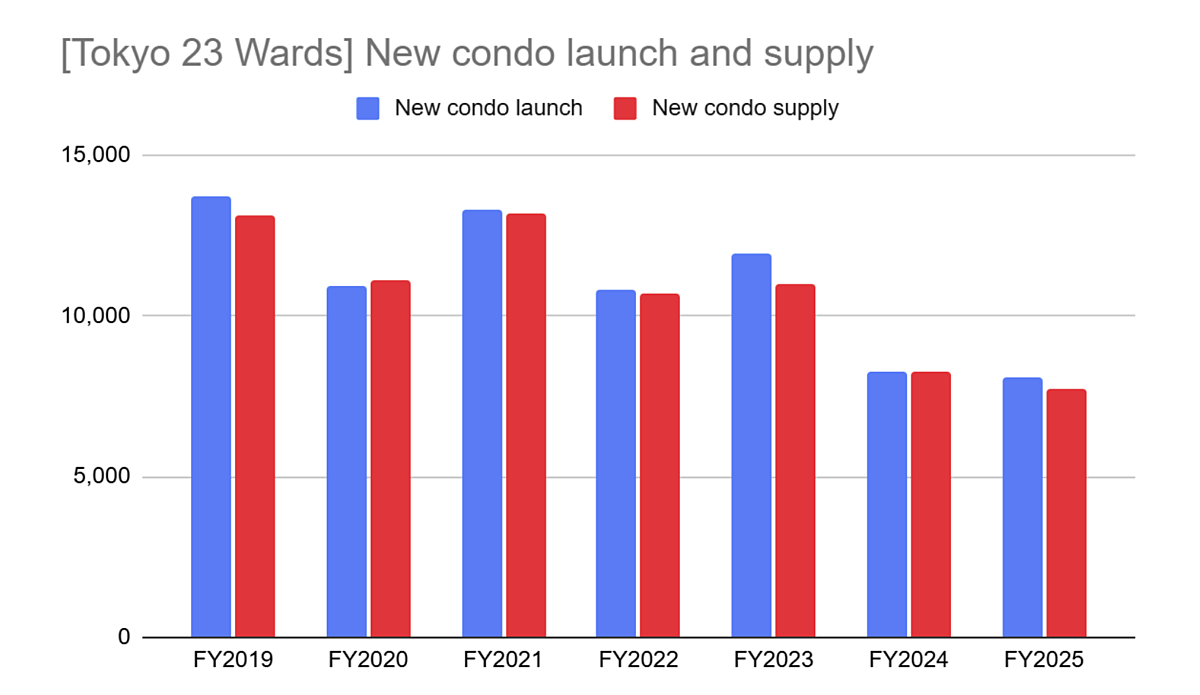
In FY2025, New condo launches in the Tokyo 23 wards decreased for four consecutive years (at 8,064 units).
According to Real Estate Economic Institute Co., Ltd. (REEI), the number is the lowest since its survey started in 1973.
The Tokyo 23 wards’ condo supplies are also decreasing.
This is mainly due to the hike in construction costs and difficulty in acquiring land for condominium development.
In Tokyo and other major metropolitan areas, many prime locations with excellent access to transportation and daily amenities have already been developed, leaving only a limited amount of land available for new projects.
As a result, competitive bidding among developers is common for scarce development sites, leading to consistently high land acquisition prices.
The average condo unit price and average price per square meter have continued to rise, with new condominium prices in Tokyo’s 23 wards averaging over ¥137 million and reaching record highs in 2025.
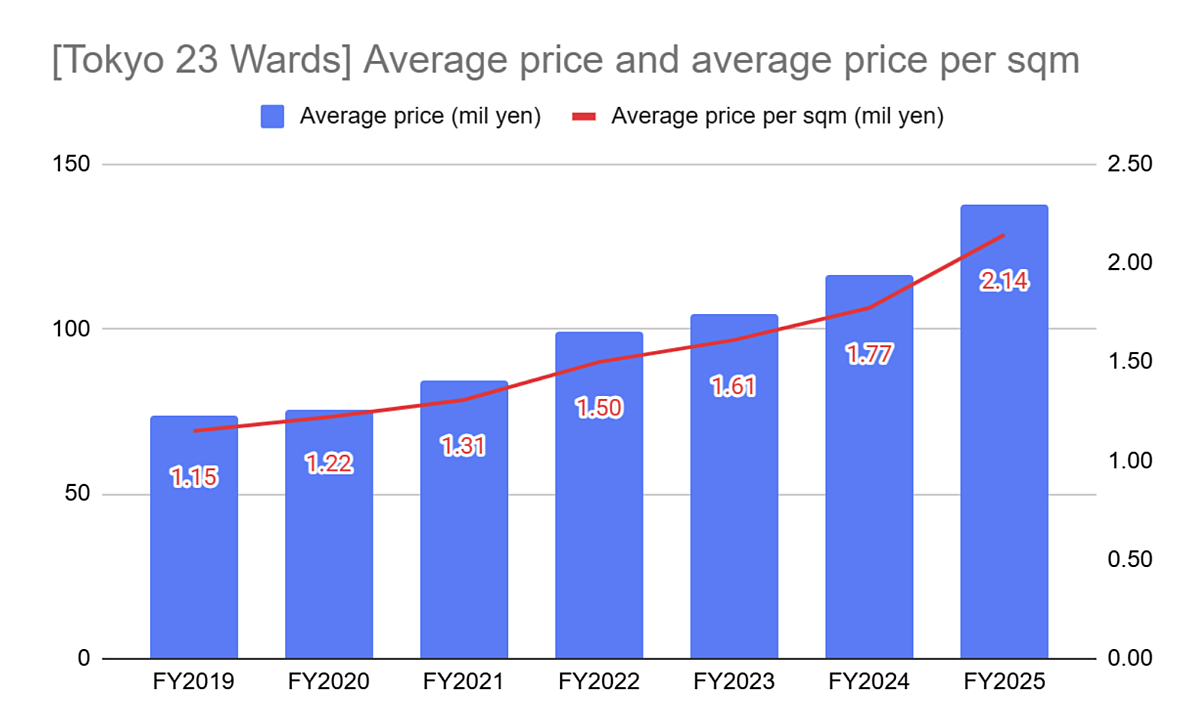
This is due to a number of factors, including soaring prices for construction materials, rising labor costs, higher energy prices, and international logistics disruptions.
As of 2025, as the survey by REEI reveals, construction costs have risen by approximately 20% compared to 2000, suggesting a shift from mere cyclical inflation to a phase of structural cost increases.
In particular, for reinforced concrete apartment buildings, steel prices and labor costs have a significant impact, creating a structure where rising construction costs are easily passed on directly to sales prices.
As a result, prices for new condominiums are rising at an accelerating pace nationwide, and particularly in urban areas including Tokyo.
According to the Survey on Actual Wages in the Private Sector conducted by the National Tax Agency of Japan, the average annual wage in Japan in 2024 was ¥4.78 million, while the average annual wage for full-time employees was ¥5.45 million.
Average Wage in Japan
(Source: Survey on Actual Wages in the Private Sector)
There are increasing instances where housing prices exceed the range that typical end-users can easily afford.
2. Tokyo Housing Market Outlook for 2026
Tokyo’s real estate market is expected to remain strong in 2026, especially in the luxury residential segment, supported by foreign investment, infrastructure quality, and economic resilience.
New housing construction is declining due to rising construction costs, labor shortages, and tighter regulations, which may further constrain supply in 2026.
As prices for new properties increase, more middle-class domestic buyers are shifting toward the secondary (used) property market, where transaction activity has been growing significantly.
Despite possible future regulations on foreign ownership and potential Bank of Japan interest rate hikes that could influence investment behavior and financing costs, the overall outlook suggests continued price growth in Tokyo’s prime residential market, although the affordability gap between luxury buyers and ordinary residents is expected to widen further.
Also read:
🔗 Tokyo Real Estate Outlook 2026: Market Trends and Investment Forecast
3. How Could Tokyo Housing Prices Move in the Future?
In the Tokyo housing market, prices are expected to remain high overall, with central Tokyo becoming even stronger and polarization between prime areas and suburbs accelerating.
1. Housing supply shortages will likely continue in 2026 and beyond
As we saw in the first chapter, in 2025, new condominium supply in the Greater Tokyo area fell to around 21,000 units, the lowest level since 1973.
The main causes for this new housing supply falling to historically low levels are:
- Rising construction costs
- Labor shortages
- Overtime restrictions in construction (the “2024 problem”)
- Limited land availability, especially in the central areas
- Competition from large-scale redevelopment projects.
These causes are not temporary but structural issues.
Therefore, developers may want to build but cannot build enough, and only high-end luxury projects remain financially viable for them.
2. Population concentration into Tokyo is continuing
Japan’s total population is shrinking, but the Tokyo metropolitan area continues attracting residents.
In 2025, net migration into the Tokyo area was still around 120,000 people. (Source: Japan Times)
This marks the third consecutive year of increases since the dip during the COVID-19 pandemic.
Net Migration into Tokyo (1989 to mid-2024)
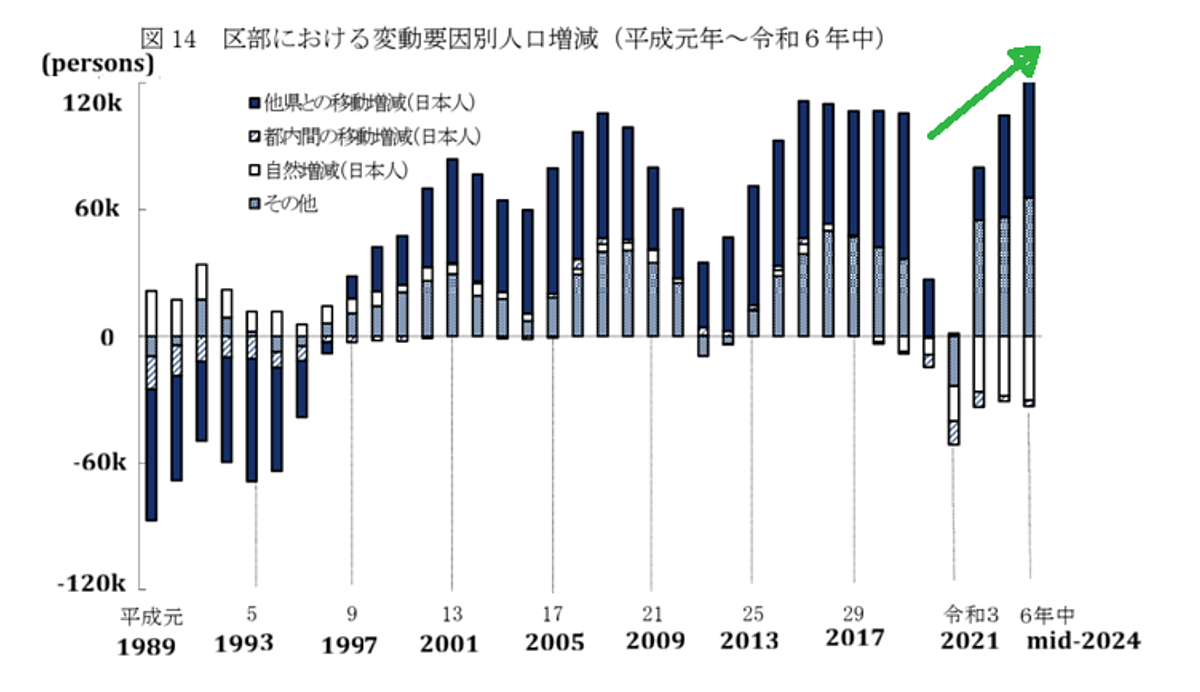
The inflow is especially strong among, young professionals, foreign skilled workers, and employees in technology, finance, and global firms.
This structure means that Tokyo still maintains strong housing demand despite Japan’s shrinking population.
3. Central Tokyo’s prime wards may continue outperforming in 2026 and beyond
The strongest areas are likely to remain:
- Minato
- Chiyoda
- Shibuya
- Chuo
- Shinjuku
- Bunkyo
These central wards could continue seeing price appreciation. The reasons include:
(i) Scarcity
Land supply in central Tokyo is extremely limited.
(ii) Wealth concentration
Demand from domestic wealthy buyers, foreign investors, and corporations remains strong.
(iii) Weak yen
From an international perspective, Tokyo real estate still appears relatively affordable, especially due to the weak yen.
Other than these 6 wards, Koto and Taito are also popular for its
- Excellent access to the city center
- Perfect blend of convenience and abundant nature
- Fusion of traditional downtown charm and modern trends
The biggest appeal of the eastern part of Tokyo is that real estate prices there are more reasonable compared to the three central wards (Chiyoda, Chuo, and Minato), making it ideal for a wide range of people, from families to singles.
Also read:
🔗 Buying Property in Japan: Does a Weak Yen Benefit Foreign Investors?
(iv) Relatively low interest rates
Japan still has lower interest rates than most major economies.
The Bank of Japan, at its monetary policy meeting in December 2025, raised the target for the unsecured call rate (overnight) to 0.75% (the third rate hike in this cycle, following those in July 2024 and January 2025).
Given that real interest rates are at extremely low levels, the Bank has indicated its intention to raise the policy interest rate and adjust the degree of monetary easing in response to improvements in economic and price conditions.
The expectation that the Bank of Japan’s policy rate will ultimately reach 1.5% is currently the most widely held view among market participants and economists.
However, the Bank decided against raising rates at the Monetary Policy Meeting on April 28, noting the risk of a downturn in the economy with the backdrop of concerns about rising prices due to the sharp surge in crude oil prices following the deterioration of the situation in Iran.
(Source: Mitsubishi UFJ Research and Consulting, Nikkei)
For risk and scenario analysis depending on the BOJ’s monetary policy, also read:
4. Tokyo is transforming - big redevelopment projects ongoing
In addition to the redevelopment projects in Tokyo featured in our previous article, “Tokyo’s Top 4 Redevelopment Hotspots: Key Areas for Foreign Investors,” many more large-scale projects are underway, with planned completion dates between 2026 and 2030 and beyond.
Chiyoda Ward: Development is underway, primarily in the Otemachi and Uchikanda areas, with the aim of strengthening the ward’s role as an international financial hub. Two new iconic office buildings are slated to be completed in 2026 (Otemachi Gate Building) and 2028 (Torch Tower).
Chuo Ward: The most active development is taking place in the Yaesu and Nihonbashi areas. As a National Strategic Special Zone around Tokyo Station, multiple skyscrapers are currently under construction simultaneously. Notable buildings include TOFROM YAESU (completed in February 2026) and Tokyo Midtown Nihonbashi (scheduled to open in 2027).
Minato Ward: Large-scale development continues in the Shinagawa, Toranomon, and Hamamatsucho areas as part of efforts to establish them as international business hubs. Takanawa Gateway City saw its grand opening in March 2026.
Shibuya Ward: A “once-in-a-century” major redevelopment is underway around Shibuya Station. Scheduled for phased completion between fiscal years 2027 and 2034, this project will further solidify the area’s position as a major hub for the IT and creative industries.
Shinjuku Ward: A long-term redevelopment plan through 2040 is underway in the Nishi-Shinjuku area. A 23-story mixed-use headquarters building for Meiji Yasuda Life Insurance Company is scheduled for completion at the southwest exit of Shinjuku Station in August 2026, while a 48-story building on the former Odakyu Department Store site is scheduled for completion in 2029.
4. Summary
Tokyo housing prices are expected to stay high through 2030 due to limited new supply, rising construction costs, labor shortages, and strong demand.
Key trends:
- New condo supply in Tokyo hit its lowest level since 1973 in 2025.
- Average new condo prices in Tokyo’s 23 wards exceeded ¥137 million, reaching record highs.
- Demand remains strong because Tokyo continues attracting residents, foreign investors, and high-income professionals despite Japan’s population decline.
- Prime central wards such as Minato, Shibuya, and Chiyoda are expected to outperform suburban areas.
- More middle-class buyers are shifting to secondhand homes as new properties become less affordable.
- A weak yen and relatively low Japanese interest rates continue supporting foreign investment.
Overall, the article predicts continued price growth in central Tokyo, with affordability gaps widening further.
(Note) The data contained in this article has been obtained and processed from various sources; we do not guarantee its accuracy or reliability.
Furthermore, this article is intended solely for informational purposes, and the opinions and forecasts contained herein are not intended to solicit the conclusion or termination of any contract.
Our team of seasoned professionals at PropertyAccess is dedicated to helping you navigate Japan’s real estate market with confidence.
With deep local knowledge and a commitment to personalized service, our experts are here to guide you every step of the way.
Book a Free Consultation Session with Our Team!
プロパティアクセスの経験豊富な専門チームが、お客様が安心して日本の不動産市場に投資いただけるようお手伝いいたします。
不動産に全般に関する豊かな知識とおひとりおひとりに合ったサービスで、不動産投資のプロセスを一貫してサポートしますので、お気軽に個別相談をご利用ください。
無料の個別相談を予約する(予約画面は英語で表示されます)