
How to Get a Property Loan in Japan as a Foreigner: Requirements, Banks & Tips
Last Updated: September 8, 2026
Can foreigners get a home loan in Japan? Learn about eligibility, permanent residency, lenders, and financing options.
Table of Contents

Supervised By: Hiroki Kazato
“Can non-Japanese citizens obtain a home loan in Japan?”
“Does a foreigner need resident status when applying for a home loan?”
As the number of foreign nationals working and living in Japan continues to grow, we receive questions asking whether non-Japanese citizens can obtain a home loan in Japan.
The answer is yes, foreign nationals can obtain a home loan in Japan in certain circumstances.
However, not all financial institutions accept foreign applicants under the same conditions.
One of the most important factors is whether the applicant has permanent residency in Japan.
For foreign real estate investors, it is also essential to clearly distinguish between a home loan for owner-occupied housing and a real estate investment loan for rental or investment properties.
This article explains the basic requirements for foreign nationals seeking a home loan in Japan, the options available to those without permanent residency, and financing strategies for foreign real estate investors.
If you would like to know the entire process of home buying in Japan, please read the following article:
🔗 A Complete Guide to Buying Property in Japan
Can Foreign Nationals Get a Home Loan in Japan?
1. Can Foreign Nationals Get a Home Loan in Japan?
Yes. Foreign nationals can obtain home loans in Japan, but eligibility varies significantly by financial institution.
Permanent residency is an important factor.
Some lenders generally require foreign applicants to have permanent residency, while others accept applications from foreign nationals without permanent residency under certain conditions.
For example:
| Financial Institution / Program | Foreign Nationals Without Permanent Residency |
| Mizuho Bank | Generally not eligible |
| MUFG Bank | Residency status required for preliminary screening |
| Sumitomo Mitsui Banking Corporation (SMBC) | Applications are possible, subject to conditions and screening |
| Flat 35 | Not eligible |
| SMBC Trust Bank PRESTIA | Applications possible under certain conditions |
| Shinsei Bank | Applications possible but the spouse must be a Japanese citizen or hold a permanent resident permit, and becomes a co-guarantor |
| Tokyo Star Bank | Applications possible under certain conditions |
| Suruga Bank | Applications possible under certain conditions |
| Hana Bank | Applications possible but the loan term is around 10 years |
The important point is that there is no single rule for all banks.
Your nationality, residence status, income, employment, Japanese or English communication ability, and other circumstances can affect your eligibility.
2. Why Permanent Residency Matters
Permanent residency can significantly expand the range of financing options available to foreign nationals.
Permanent residency gives lenders greater confidence that the borrower is likely to remain in Japan long-term with a stable income, making it easier for them to assess the borrower’s ability to repay the loan.
This is important because lenders are concerned about the possibility of a borrower leaving Japan before the loan is fully repaid.
For example, Mizuho Bank generally requires foreign applicants to have permanent residency or an equivalent status.
MUFG Bank's online preliminary screening is also available to Japanese nationals and foreign nationals with permanent residency who reside in Japan.
Flat 35 similarly requires foreign applicants to have either Permanent Resident or Special Permanent Resident status.
However, not having permanent residency does not automatically make a home loan impossible.
SMBC accepts applications from certain foreign nationals without permanent residency, while SMBC Trust Bank PRESTIA also accepts applications from foreign nationals residing in Japan who hold an eligible status of residence.
Its stated requirements include a stable annual income of at least JPY 10 million in the previous fiscal year.
The key is therefore to identify lenders that accept applicants with your particular residence status and to demonstrate stable income and a stable financial situation, as lenders are primarily concerned with credit risk.
3. Home Loans vs. Real Estate Investment Loans
Foreign nationals should be aware that home loans and real estate investment loans are two distinct types of financing in Japan.
The first step is therefore to determine the purpose of the property purchase, as this will influence which type of loan is appropriate.
Home loan
A home loan is generally designed for a property that the borrower will occupy.
Home loans generally cannot be used to purchase rental or investment properties.
Real estate investment loan
If you are purchasing a property to generate rental income, you will generally need a financing product intended for investment purposes.
This includes:
- Rental condominiums
- Apartment buildings
- Investment houses
Using a home loan to purchase an investment property may violate the lender's terms.
The Japan Housing Finance Agency also warns against the improper use of Flat 35 for investment properties.
In simple terms:
Owner-occupied property → Home loan
Rental/investment property → Real estate investment loan
If you are looking to use financing for investment property, you will need to look for a financial institution that offers real estate investment loans to foreign nationals.
4. What Do Banks Consider?
Banks consider more than nationality or permanent residency when reviewing a loan application.
Here are the main factors banks look at when assessing your application:
Status of residence
As we mentioned earlier, your residence status can affect which lenders and loan products are available to you.
Permanent residency generally provides more options.
However, even without permanent residency, some lenders may consider your application if you can demonstrate that you have established a stable life in Japan.
Residence in Japan
Some lenders require applicants to reside in Japan.
Income and financial stability
Banks assess whether you have sufficient and stable income to repay the loan.
Investment loans may have additional income requirements.
Employment history
Length of employment can also affect screening.
If you have recently changed employers, the lender may examine your circumstances more closely.
Japanese or English communication ability
Some lenders require foreign applicants to demonstrate that they can understand the loan agreement and communicate independently.
For example, SMBC requires certain foreign applicants without permanent residency to communicate independently in Japanese and understand the contractual documents.
PRESTIA accepts applicants who can communicate in either Japanese or English.
Existing debt and available funds
Banks may also consider your existing debt, savings, available funds, and the property being purchased.
Spouse’s Nationality
Some lenders require your spouse to be a Japanese citizen or a permanent resident and to guarantee your repayment obligations.
5. Documents You May Need
The exact requirements vary by lender, but foreign applicants may be asked to provide:
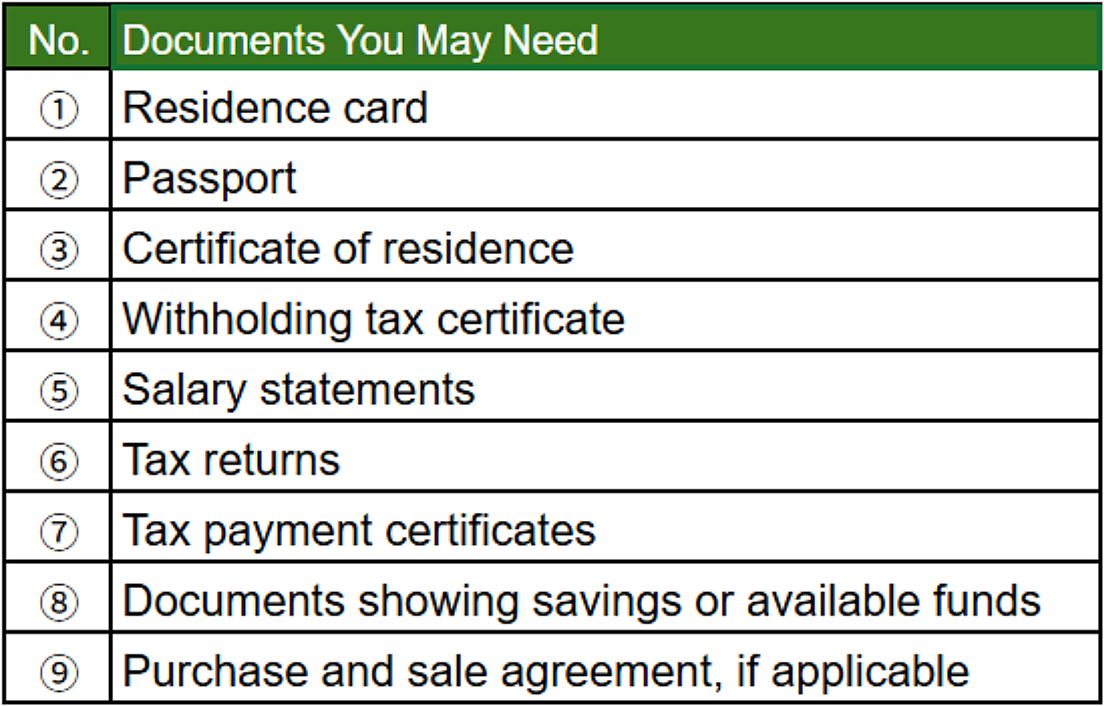
For example, SMBC requires foreign applicants to provide identification and residence-related documents, as well as documents verifying income.
It is advisable to prepare these documents before beginning the application process.
6. How to Apply for a Loan
The basic process is similar to that for Japanese applicants.
Step 1: Review your financial profile
Prepare information about:
Step 2: Identify suitable lenders
Compare financial institutions based on your circumstances.
Do not assume that all banks require permanent residency.
Some lenders accept foreign nationals without permanent residency under specific conditions.
Step 3: Apply for preliminary screening
After identifying a suitable lender and property, you can apply for preliminary screening.
Passing preliminary screening does not guarantee final approval.
Step 4: Complete full screening
The lender conducts a more detailed review of your finances, existing debt, personal circumstances, and the property.
Step 5: Execute the loan
After final approval, you enter into the loan agreement, complete the required procedures, and receive the loan funds.
Summary
Foreign nationals can obtain loans to purchase real estate in Japan, but eligibility depends heavily on the lender and the applicant's circumstances.
If you are a foreign national considering a loan in Japan, keep these five points in mind:
1. Permanent residency matters.
It generally gives foreign applicants access to a broader range of home loan options, although some lenders accept applicants without it.
2. Banks have different requirements.
Do not assume that one bank's policy applies to all financial institutions.
3. Choose the right type of loan.
A home loan is generally for owner-occupied property, while rental and investment properties require real estate investment financing.
4. Your overall financial profile matters.
Income, employment history, residence in Japan,
existing debt, available funds, and communication ability may all affect screening.
5. Consider taxes at the same time as financing.
Foreign investors may face tax obligations in both Japan and their country of tax residence.
Loan requirements, interest rates, eligible properties, and other conditions can change.
Always check the latest requirements with the relevant financial institution before applying.
Our team of seasoned professionals at PropertyAccess is dedicated to helping you navigate Japan’s real estate market with confidence.
With deep local knowledge and a commitment to personalized service, our experts are here to guide you every step of the way.
Book a Free Consultation Session with Our Team!