Stamp Duty on Real Estate Transactions: Japan vs. Singapore, Malaysia, the Philippines, and the US
Last Updated: 10월 5, 2026
Compare real estate stamp duty in Japan, Singapore, Malaysia, the Philippines, and the U.S. for investors.
목차
-
Japan: Stamp Tax on the Real Estate Sale Contract
-
Singapore: Buyer's Stamp Duty and Additional Buyer's Stamp Duty
-
Malaysia: Stamp Duty on the Transfer of Property
-
Philippines: Documentary Stamp Tax on Real Property Transfers
-
United States: State and Local Transfer Taxes
-
How Do the Five Countries Compare?
-
Summary

Supervised By: Nobuyuki Ohki
Expert in Real Estate Taxation (CPA, Tax Accountant, Real Estate Transaction Specialist)
When investing in real estate, the purchase price is only one part of the transaction cost.
Depending on the country, buyers may also have to pay taxes on the documents used to purchase or transfer the property.
These taxes are commonly referred to as stamp duty, although the rules vary from country to country.
For international investors considering Japanese real estate, understanding these differences can help put Japan's relatively low transaction-related stamp tax into perspective.
This article compares the real estate stamp-duty systems in Japan, Singapore, Malaysia, the Philippines and the US, with an illustrative calculation based on a property worth JPY 100 million equivalent.
[Important] The calculations below are simplified comparisons and for illustrative purposes only. They do not represent the complete tax cost of acquiring property.
Exchange rates are assumed solely for comparison and should not be used for an actual transaction.
In this article, we will be looking at the following countries:
- Japan
- Singapore
- Malaysia
- Philippines
- US (New York)
1. Japan: Stamp Tax on the Real Estate Sale Contract
Japan imposes Stamp Tax (印紙税, inshi-zei) on certain taxable documents, including contracts for the sale or transfer of real estate.
A real estate sale and purchase agreement generally falls under the category of taxable documents relating to the transfer of real estate.
The amount of tax is determined by the contract price stated in the agreement, rather than by applying a percentage directly to the property price.
Current stamp tax rates
Currently, a reduced stamp-tax schedule applies to qualifying contracts with a stated contract price exceeding JPY 100,000.
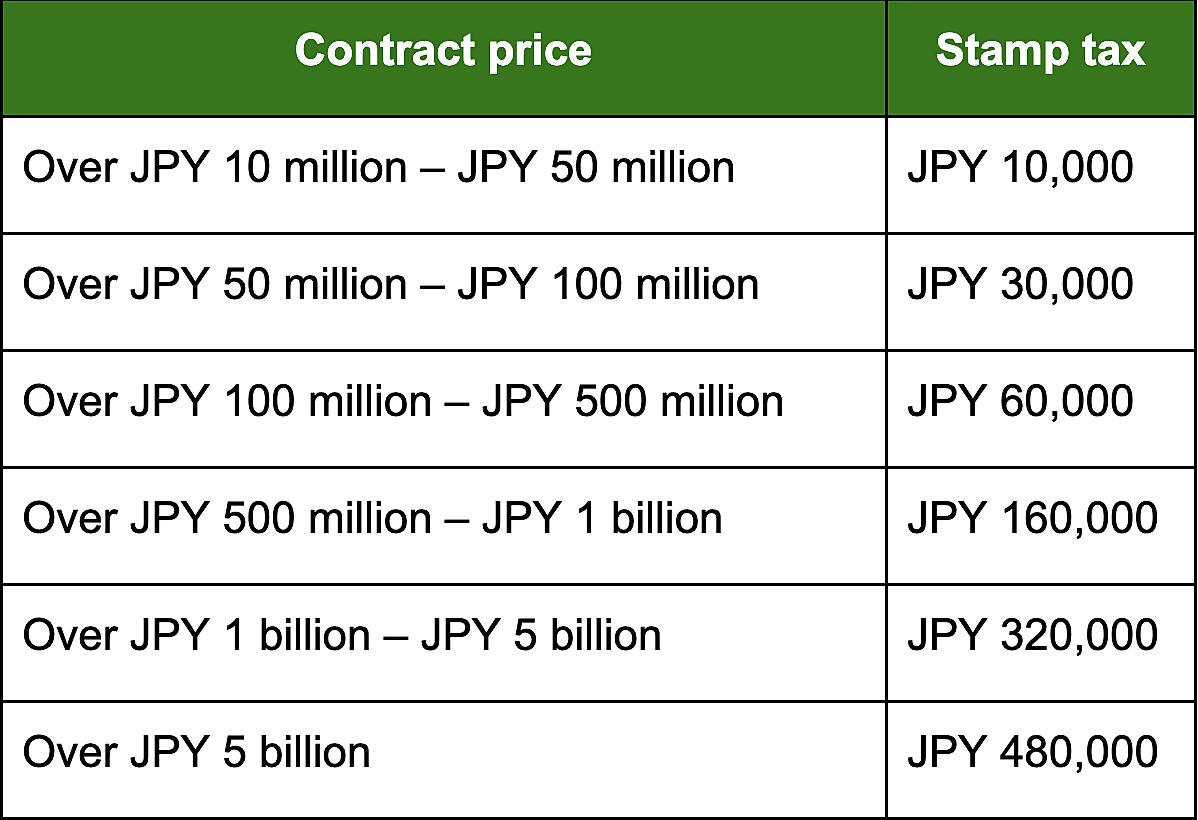
The reduced rate is currently scheduled to apply to qualifying contracts prepared between April 1, 2014 and March 31, 2027.
Example: JPY 100 million property
Suppose an investor purchases a Japanese property at a price of exactly JPY 100 million.
Because the contract price falls within the JPY 50 million–JPY 100 million bracket, the stamp tax on the real estate sale contract is JPY 30,000.
This is only 0.03% of the JPY 100 million purchase price.
The important point for investors is that Japan's stamp tax is not a simple percentage of the property value.
At higher property prices, the tax increases in fixed brackets rather than proportionally with the purchase price.
One more thing to note is that Japanese stamp tax is imposed only on contracts prepared in paper form.
This means that stamp tax does not apply to real estate contracts executed in digital format.
However, investors should also keep in mind that this does not apply where a contract is initially prepared in paper form and subsequently converted into digital format.
For other taxes imposed on a property transaction, please refer to the following article:
Japan Property Tax for Foreigners: Tax Rates, Costs & Rules Explained
2. Singapore: Buyer's Stamp Duty and Additional Buyer's Stamp Duty
Singapore's system is significantly different from Japan's.
When purchasing Singapore real estate, the buyer generally has to consider Buyer’s Stamp Duty (BSD).
BSD applies to documents executed for the sale and purchase or transfer of Singapore property, and is calculated based on the higher of the purchase price or market value.
For residential property, certain buyers may also have to pay Additional Buyer’s Stamp Duty (ABSD).
Buyer's Stamp Duty
For property acquired on or after February 15, 2023, the BSD rates are progressive:
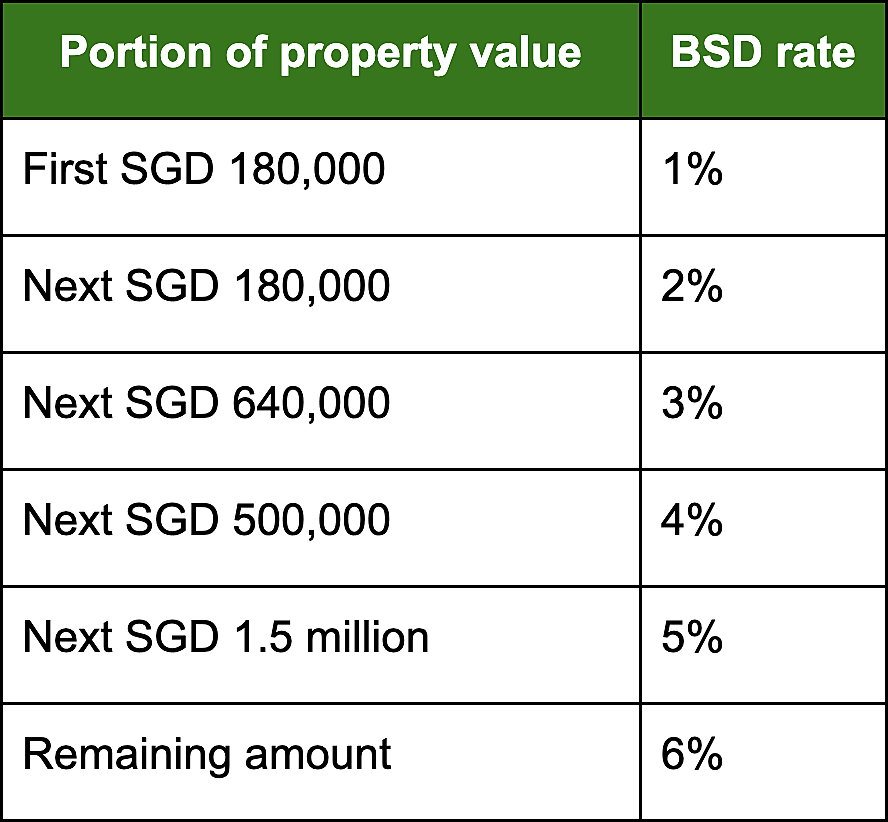
For non-residential property, the top marginal BSD rate is 5% rather than 6%.
(Source: Buyer's Stamp Duty (BSD), Inland Revenue Authority of Singapore)
Additional Buyer's Stamp Duty for foreign investors
Singapore is particularly important for international investors because ABSD can substantially increase the acquisition cost.
As of 2026, foreigners purchasing residential property in Singapore are subject to ABSD at 60%.
Entities purchasing residential property are generally subject to a 65% ABSD rate.
For purchases made between two or more buyers of different buyer profiles, the highest applicable ABSD rate will be applied to the entire amount of property purchased.
Certain exemptions or concessions can apply depending on the buyer and circumstances.
(Source: Additional Buyer’s Stamp Duty (ABSD), Inland Revenue Authority of Singapore)
Example: JPY 100 million property
For illustration, assume:
JPY 100 million = SGD 833,333 (exchange rate of SGD 1 = JPY 120)
For a residential property, the BSD would be as follows:
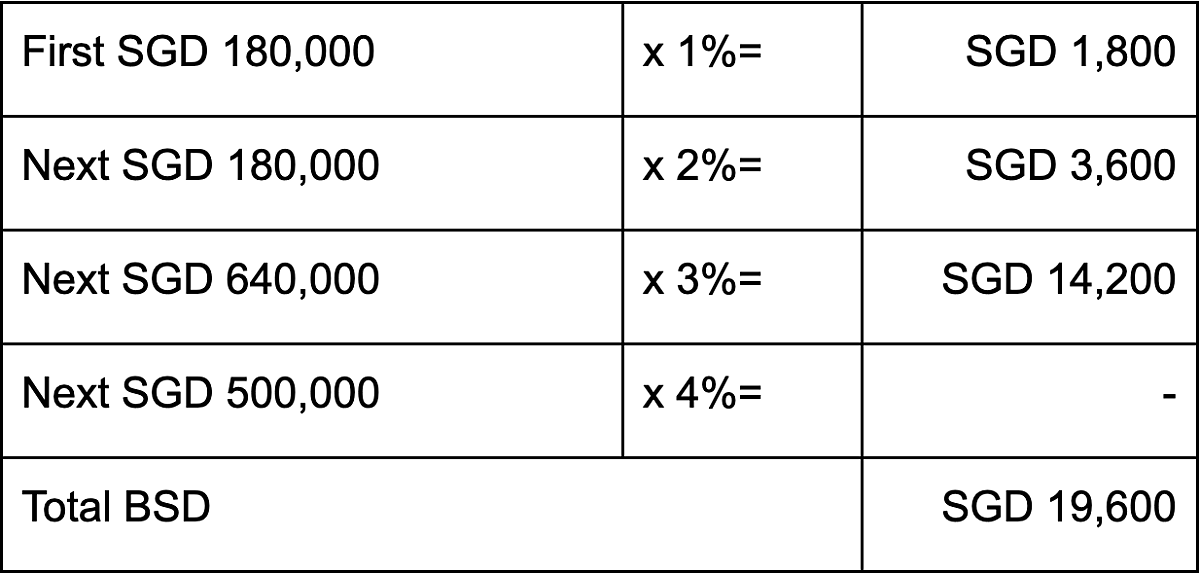
BSD for a JPY 100 million property will be SGD 19,600, or approximately JPY 2.35 million.
However, for a foreign individual purchasing residential property, the 60% ABSD would add approximately:
SGD 833,333 × 60% = SGD 500,000
or approximately JPY 60 million.
Therefore, the combined BSD and ABSD would be approximately:
JPY 62.35 million
This is dramatically different from Japan's JPY 30,000 stamp tax.
The comparison is not entirely like-for-like, however. Singapore's ABSD is a substantial acquisition tax based on the buyer's profile, whereas Japan's Stamp Tax is specifically a tax on the taxable document.
3. Malaysia: Stamp Duty on the Transfer of Property
Malaysia also uses an ad valorem stamp duty system for property transfers.
Under the Malaysian Stamp Act 1949, stamp duty is imposed on instruments listed in the First Schedule.
An instrument transferring property is subject to ad valorem duty, meaning that the amount depends on the consideration or relevant property value.
While for a Malaysian citizen progressive rates are applied, a flat rate is applied to foreign individuals (except Malaysia PRs) and companies.
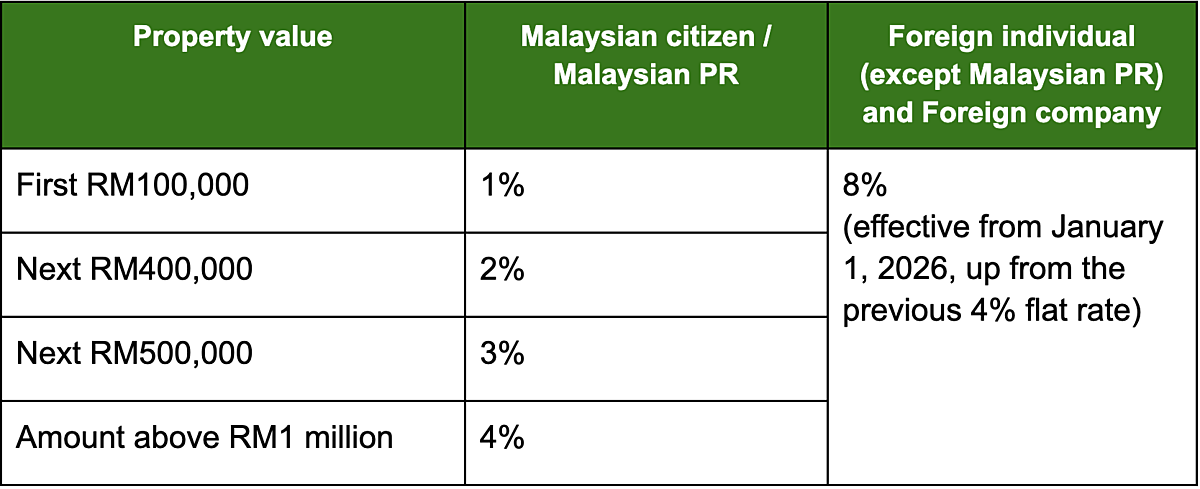
The applicable basis is generally the higher of the consideration and the market value.
The Malaysian Government’s official Budget 2026 Tax Measures introduced a higher fixed stamp duty rate on the instruments of transfer of residential homes executed by non-citizen individuals (except Malaysian permanent resident) and foreign companies of 8%, up from the previous 4%.
The change was actually enacted by the subsequent amendment of the Finance Act 2025 (Act 874).
The amendment is effective on sale of any residential property from 1 January 2026 to a foreign company or individual (except Malaysian permanent resident).
Example: JPY 100 million property
For illustration, assume:
JPY 100 million = RM2.857 million
using an assumed exchange rate of RM1 = JPY 35.
The estimated stamp duty would be:
RM2.857 million x 8% = RM228,571
or approximately JPY 8 million
Malaysia therefore has a substantially higher property-transfer stamp-duty burden than Japan for a property of this value.
It is also worth noting that Malaysia distinguishes between different instruments.
Under section 4(3) of the Stamp Act 1949, if several instruments are employed to complete a sale, lease, charge, settlement, exchange or partition, the principal instrument is chargeable with the duty prescribed in the First Schedule and each of the other instruments is generally chargeable with a fixed duty of RM10.
(Source: Malaysia Inland Revenue Board (HASiL) — Stamp Duty)
4. Philippines: Documentary Stamp Tax on Real Property Transfers
In the Philippines, the equivalent tax is generally called Documentary Stamp Tax (DST).
The tax applies to certain documents and instruments, including those evidencing the sale or transfer of real property.
The Bureau of Internal Revenue (BIR) administers the tax, and its One-Time Transaction (ONETT) process is used for transactions involving real property.
For a real property conveyance, the DST is generally calculated at:
PHP 15 for every PHP 1,000, or fraction thereof
of the relevant tax base.
That is effectively 1.5%. BIR's real-property transaction computation materials identify Section 196 of the National Internal Revenue Code as the legal basis and use the formula of PHP 15 for every PHP 1,000 or fraction thereof.
The tax base for real-property transactions can be important because the relevant value is not necessarily limited to the stated sale price. BIR's transaction documentation uses the highest of the selling price, zonal value and applicable fair market value as the tax base in the relevant calculations.
Example: JPY 100 million property
For illustration, assume:
JPY 100 million = PHP 38.46 million
using an assumed exchange rate of PHP 1 = JPY 2.60.
At a 1.5% DST rate:
PHP 38.46 million × 1.5% ≈ PHP 576,923
This is approximately:
JPY 1.50 million
Thus, the illustrative Documentary Stamp Tax would be around JPY 1.5 million.
(Source: Philippines Bureau of Internal Revenue — Documentary Stamp Tax)
5. United States: State and Local Transfer Taxes
The United States does not have a nationwide federal stamp duty equivalent to Japan's Stamp Tax on real estate sale contracts.
Instead, taxation is left to state and local governments, often called Transfer Taxes, Deed Taxes or Documentary Stamp Taxes.
As a result, the tax payable when purchasing a property depends on where the property is located.
According to the Florida Office of Economic and Demographic Research, 37 states, the District of Columbia and New York City impose taxes on the recording of certain documents or on property transfers, while other states do not impose such taxes at the state level.
For example, California authorizes local transfer taxes rather than imposing a statewide transfer tax.
On the other hand, New York levies combined city and state transfer taxes.
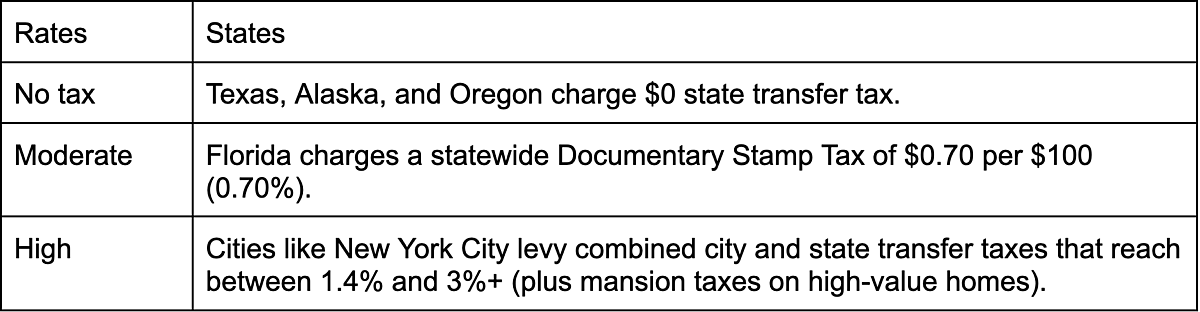
This means that there is no single U.S. stamp-duty rate that can be applied to a JPY 100 million property.
Example: JPY 100 million property
Since there is no nationwide stamp duty, we use New York City as an illustration.
In New York City, a property equivalent to JPY 100 million can be subject to state and city transfer taxes.
For illustration, assume:
JPY 100 million = USD 666,667
using an assumed exchange rate of USD 1 = JPY 150.
1. New York City transfer tax (Source: NYC Department of Finance)
For a residential Type 1 or Type 2 transfer valued at more than USD 500,000, NYC's RPTT rate is 1.425%.
USD 666,667 × 1.425% = approximately USD 9,500
2. New York State transfer tax (Source: NYS Department of Taxation and Finance)
New York State also imposes a real estate transfer tax on qualifying conveyances. The State tax generally applies when the consideration exceeds USD 500.
The standard NYS rate is 0.4% (two dollars for each $500, or fractional part thereof, of consideration).
USD 666,667 × 0.4% = approximately USD 2,667
Total transfer taxes is USD 12,167.
This is approximately:
JPY 1.83 million
One important point is that these transfer taxes are generally seller-side taxes in New York, rather than a buyer stamp duty comparable to Japan's stamp tax.
6. How Do the Five Countries Compare?
When you are buying property in Japan, Singapore, Malaysia, Philippines and the US as a foreigner, this is the comparison table of tax equivalent to Japan’s stamp tax.
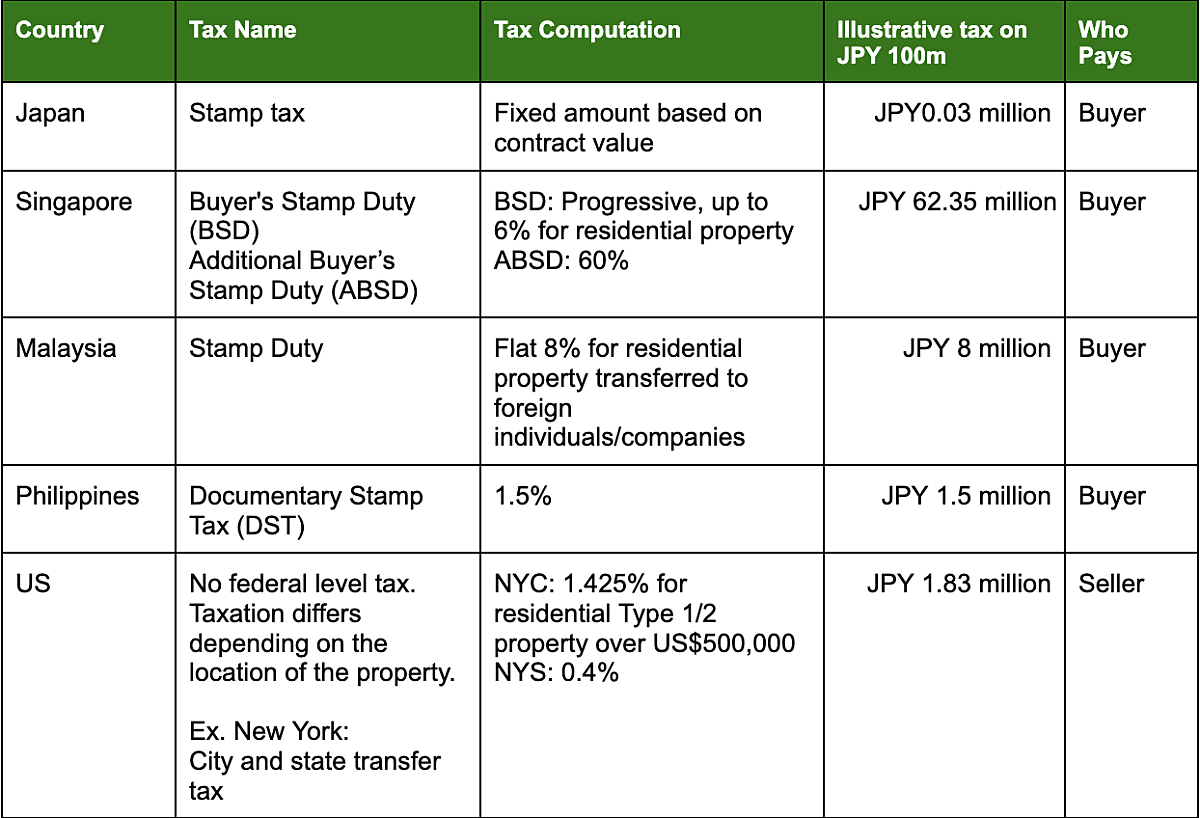
The comparison illustrates one important characteristic of Japan's system.
Japan's real estate Stamp Tax is relatively small compared with the percentage-based property acquisition or transfer taxes found in several other Asian markets.
The US, on the other hand, does not have a federal real-estate stamp tax comparable to Japan's Stamp Tax.
7. Summary
Stamp duty can look similar but the underlying tax systems can be very different.
In Japan, Stamp Tax is primarily a tax on the taxable real estate contract, with a fixed amount determined by the contract price. Under the current reduced schedule, a JPY 100 million transaction attracts just JPY 30,000 of Stamp Tax.
In Malaysia and the Philippines, property-transfer instruments are generally subject to ad valorem stamp or documentary taxes, making the tax substantially more sensitive to the value of the property.
Singapore goes further by combining Buyer’s Stamp Duty with Additional Buyer’s Stamp Duty, with particularly significant consequences for foreign buyers of residential property.
However, stamp duty is only one part of the acquisition cost.
Real estate transactions can involve several other taxes and expenses, including registration and transfer-related taxes, real property taxes, mortgage-related taxes, legal and professional fees.
Therefore, stamp duty should be viewed as one component of the overall transaction-cost structure, rather than as a measure of the total tax burden associated with a real estate investment.
<Disclaimer>
The tax information on this article is for general informational purposes only and does not constitute tax advice or guarantee the legality or accuracy of any tax return.
Tax laws and regulations are subject to change. While we strive to keep the information accurate and up to date, we cannot guarantee its completeness or accuracy.
The author assumes no liability for any loss or disadvantage resulting from reliance on the information provided. For actual tax filings or individual tax matters, please consult the relevant tax authority or a qualified local tax professional.
Our team of seasoned professionals at PropertyAccess is dedicated to helping you navigate Japan’s real estate market with confidence.
With deep local knowledge and a commitment to personalized service, our experts are here to guide you every step of the way.
Book a Free Consultation Session with Our Team!
PropertyAccess의 노련한 전문가 팀은 여러분이 일본 부동산 시장을 자신 있게 탐색하실 수 있도록 최선을 다해 지원해 드립니다.
풍부한 현지 지식과 맞춤형 서비스에 대한 헌신을 바탕으로, 저희 전문가들이 부동산 구매 과정의 모든 단계에서 고객님을 안내해 드립니다.
무료 개별 상담 예약하기
(예약 화면은 영어로 표시됩니다.)