- 税務・法務
[Complete Guide] Japanese Property Tax for Foreigners: How It Works, Tax Relief & Payment
Published On: 10月 21, 2026
Learn about Japan’s property tax (fixed asset tax), including tax rates, calculation methods, tax reductions, payment deadlines, and more for foreign property owners.
目次

Supervised By: Nobuyuki Ohki
Expert in Real Estate Taxation(CPA, Tax Accountant, Real Estate Transaction Specialist)
“What is the property tax in Japan like?”
“How much is the property tax and how often do I have to pay?”
If you own or are planning to purchase real estate (land or buildings) in Japan, one essential ongoing cost you must budget for is property tax (also called fixed asset tax).
Because tax laws differ from country to country, many foreign property owners wonder: "When do I pay?", "Who is responsible?", and "What should I do when a payment notice arrives in Japanese?"
Don’t worry. In this article, we explain the basics of property tax in Japan, including how it is calculated, available tax reductions and exemptions, payment deadlines, and the different ways you can pay.
Whether you already own property in Japan or are considering buying real estate, this guide will help you understand your property tax obligations and make sure you know when and how to pay.
1. What Is Japanese Property Tax?
Let’s start with the basic definition and core framework of Japanese property tax or also called fixed asset tax (固定資産税, kotei-shisan-zei).
Property tax is a local tax levied on anyone who, as of January 1st of each year, owns land, buildings (residential or commercial), or depreciable business assets in Japan.
- Taxing Authority: The local municipality where the property is located (or the Tokyo Metropolitan Government for Tokyo's 23 wards).
- Payment Schedule: Paid in 4 annual installments (or as a lump sum).
Who Is Obligated to Pay?
The official taxpayer is the registered owner listed in the official property registry on January 1st of each year.
The tax notice is usually delivered between April and June every year.
For example, even if you sell your property in May, you will still receive the tax notice for the entire year because you were the owner on January 1st.
But in practice, buyers and sellers usually settle this pro-rata at the time of closing.
Difference Between Property Tax and City Planning Tax
Property tax notices often include an additional charge called City Planning Tax (都市計画税 /Toshi-keikaku-zei).
This tax applies to properties located within designated urban planning areas (Shigaika Kuiki) to fund local infrastructure development such as roads, parking spaces, parks, and utility services.
It is billed and paid together with your property tax.
(Source: City Planning Tax, Ministry of Internal Affairs and Communications)
2. How Property Tax Is Calculated & Assessed Value
Here is how local municipalities calculate your annual property tax bill.
Basic Calculation Formula
The standard property tax rate in Japan is 1.4%.
Property tax amount = Taxable Base (Assessed Value) x 1.4%
Municipalities may establish a rate other than 1.4% through the issuance of an ordinance.
However, major areas such as Tokyo, Osaka, Kyoto (except for a few cities outside of Kyoto City), Nagoya and Fukuoka set the rate as 1.4%.
Note:
- If City Planning Tax applies, a maximum rate of 0.3% is added, bringing the total effective tax rate to around 1.7%.
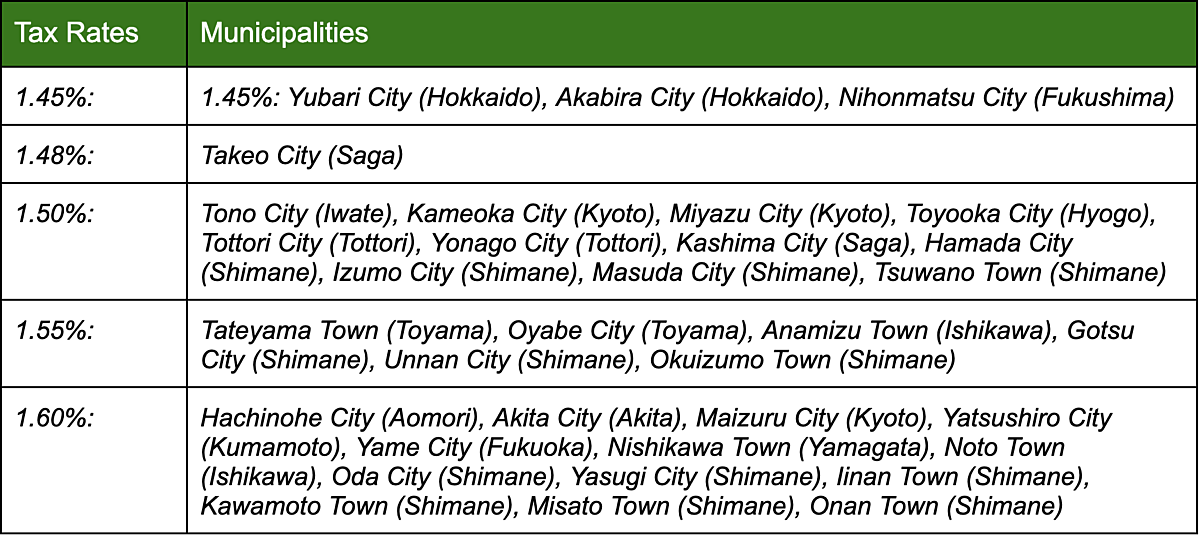
- Below are some examples of municipalities that levy more than 1.4% of property tax.
"Market Purchase Price" vs. "Assessed Value"
Investors need to bear in mind that taxes are not calculated based on the actual purchase price of the property.
Instead, calculations use the "Property Tax Assessed Value" (固定資産税評価額 - Kotei Shisan Zei Hyōkagaku), which is officially determined by the local government.
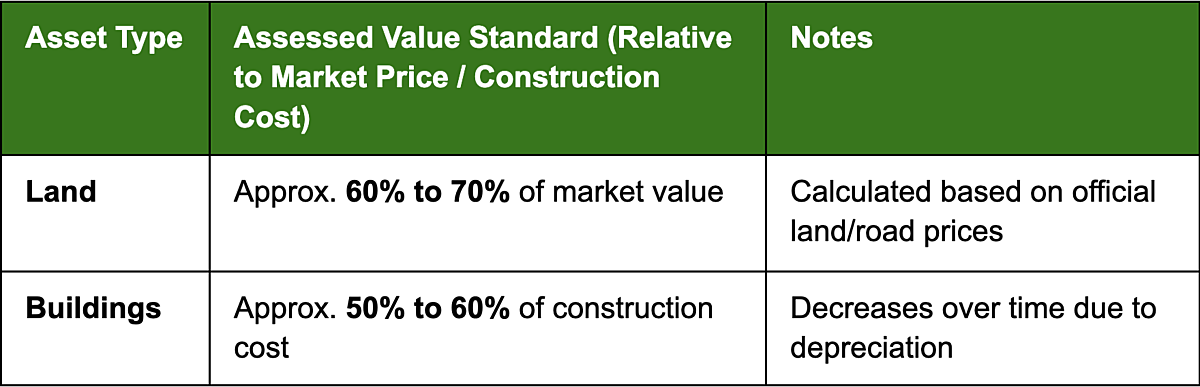
Note: Property Tax Assessed Values are officially reassessed every 3 years (known as Hyōka-gae).
(Source: Property Tax, Ministry of Internal Affairs and Communications)
3.Tax Relief & Exemption Measures
Japan offers several tax reduction incentives (Special Tax Base Exceptions) to support property owners.
① Tax Relief for Residential Land (Land Tax Reduction)
Land designated for residential use qualifies for a major reduction in its taxable base:
- Small Residential Land (up to 200 m² per unit): Taxable base is reduced to 1/6 of the assessed value.
- General Residential Land (portion exceeding 200 m²): Taxable base is reduced to 1/3 of the assessed value.
For multi-unit apartment buildings (condominiums), if the total lot size divided by the number of units is 200 m² or less per owner, the land portion of your property tax automatically benefits from the 1/6 reduced rate.
② Tax Reduction for Newly Constructed Residential Buildings
When purchasing a brand-new home or condominium completed on or before March 31, 2031, the property tax on the building portion is cut by 1/2 (50% reduction) for a set period.
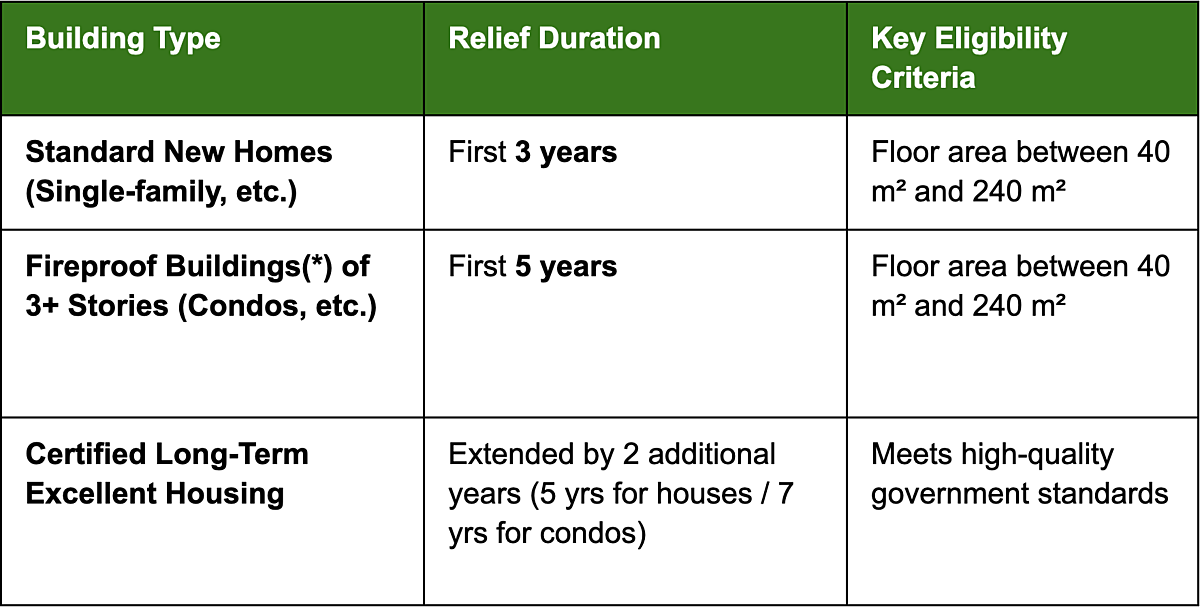
Note:
- Usually this reduction is applied automatically, but some cities require a homeowner to apply for the reduction. It is recommended to check if the application is required.
- Once this reduction period expires, your building tax will revert to its normal amount (roughly double). Keep this in mind to avoid unexpected financial surprises.
- Thanks to the tax reform effective from April 1, 2026, the floor area of a house eligible for the property tax reduction was revised from 50-280sqm to 40-240sqm so small-sized houses can also benefit from the reduction.
③ Tax Incentives for Renovations (Energy-Saving, Seismic, Accessibility)
If you buy a second-hand property and carry out certified seismic retrofitting or energy-saving renovations (e.g., installing double-glazed windows or insulation), you can file for a temporary property tax reduction for the following year.
4. Payment Schedule & Reading Your Tax Notice
Understanding when and how to pay ensures you avoid late penalties.
Annual Payment Schedule
Every year around April to June, local municipal tax offices mail out the Property Tax and City Planning Tax Payment Notice (固定資産税・都市計画税 納税通知書) to your registered address in Japan.
Standard payment deadlines are split into 4 installments:
- 1st Installment: End of April or May
- 2nd Installment: End of July
- 3rd Installment: End of December
- 4th Installment: End of February (following year)
(Note: Exact months may vary slightly depending on the municipality.)
Along with the four installment slips, you will also receive a Lump-Sum Payment Slip (一括納付用). You can choose to pay the entire year at once or in four installments; the total cost remains the same.
Key Documents Included in the Notice
- Tax Notice & Assessment Breakdown (納税通知書・課税明細書): Shows the property details, assessed value, taxable base, and itemized calculations.
- Payment Slips (納付書): Barcoded pay-in slips for over-the-counter or online payments.
5. Crucial Rules for Non-Resident Overseas Owners
If you live outside Japan while owning investment or holiday property in Japan, you must take note of special administrative requirements.
Appointing a Tax Agent (納税管理人 - Nōzei Kanri-nin)
If you reside overseas and cannot receive tax notices directly in Japan, you are legally required to appoint a Tax Agent and register them with the local government office.
The tax agent will receive tax notices on your behalf and handle local tax payments.
You can appoint a trusted friend or relative residing in Japan, or professional services such as an administrative scrivener (Gyōsei Shoshi), tax accountant (Zeirishi), or property management company.
If you reside overseas and have Japanese-source income, you will need to appoint a Tax Agent for your income tax purposes to the local tax office.
Please note that these are two different types of notifications.
Risks of Late Payment or Default
Failing to pay on time will result in delinquency charges (late fees/interest).
In severe cases, unpaid tax debts can lead to the seizure of your Japanese bank accounts or the property itself.
Always ensure payments are handled on time or assign a reliable Tax Agent.
6. Conclusion
While Japanese property tax can appear complex at first glance, understanding a few core rules makes it easy to manage:
- Tax liability is determined on January 1st each year.
- Significant tax reductions exist for residential land and new homes.
- Taxes are paid in 4 installments via convenience stores, credit cards, or mobile apps.
- Non-resident owners must appoint a Tax Agent in Japan.
By keeping these points in mind and taking full advantage of available tax relief, you can enjoy a secure and stress-free property ownership experience in Japan!
Our team of seasoned professionals at PropertyAccess is dedicated to helping you navigate Japan’s real estate market with confidence.
With deep local knowledge and a commitment to personalized service, our experts are here to guide you every step of the way.
Book a Free Consultation Session with Our Team!
プロパティアクセスの経験豊富な専門チームが、お客様が安心して日本の不動産市場に投資いただけるようお手伝いいたします。
不動産に全般に関する豊かな知識とおひとりおひとりに合ったサービスで、不動産投資のプロセスを一貫してサポートしますので、お気軽に個別相談をご利用ください。
無料の個別相談を予約する(予約画面は英語で表示されます)