Japan Moving Toward Tighter Rules on Foreign Property Ownership?
Last Updated: September 15, 2026
Japan plans tighter oversight of foreign property ownership with new disclosure rules and reporting requirements.
Table of Contents

Supervised By: Hiroki Kazato
Japan is one of the few countries where foreigners can purchase real estate with very few legal restrictions. This openness has long attracted overseas investors and buyers looking for residential, commercial, and investment properties in Japan.
However, discussions surrounding foreign ownership of Japanese real estate have intensified in recent years, leading to tighter reporting requirements and growing political momentum for stronger regulations.
If you are considering buying property in Japan, you may be wondering:
“Can foreigners still buy property freely in Japan?”
“What are the current legal requirements for foreign buyers?”
“Is Japan planning to introduce stricter foreign ownership regulations?”
In this article, we explain the current rules for foreign property ownership in Japan, recent regulatory changes, and the ongoing debate over tighter oversight of foreign-owned real estate.
By understanding the latest developments, you can better navigate Japan’s evolving property market and legal landscape.
- Growing Momentum for New Regulations
- What Regulations are Changing in Japan's Property Market?
- Current Requirements and Future Changes
- What This Could Mean for Foreign Buyers
- Summary
1. Growing Momentum for New Regulations
Japan is moving toward tighter oversight of foreign ownership of land and real estate, with the government increasingly framing the issue as both a national security concern and a housing policy issue.
Why is this?
In recent years, there have been cases where land around important infrastructures such as the self-defence force’s bases, nuclear power plants, remote islands and airports was acquired by foreign capital, which increases concerns of national security and data leakage risks.
In addition, against a backdrop of a weak yen and other factors, there has been a sharp rise in property purchases by overseas investors in Japan, causing prices for flats in central Tokyo and in resort areas to skyrocket, making it increasingly difficult for ordinary Japanese people to buy property.
Since late 2025, several ministries and ruling party lawmakers have introduced or discussed measures aimed at improving transparency around foreign ownership of land, forests, and residential property.
By March 2026, the government had formally launched an expert panel to study whether broader legal restrictions should be introduced.
While no outright ban on foreign ownership has been proposed, the policy direction suggests that Japan is gradually shifting from a largely open market toward a more monitored and regulated system.
2. What Regulations are Changing in Japan's Property Market?
(1) How Japan’s Restrictions Compare Internationally
Japan is one of the few countries that impose almost no restrictions on foreigners purchasing and owning property within its territory.

In contrast, a comparison with other Southeast Asian countries shows that they generally impose certain levels of restrictions on foreign ownership of real estate.
(2) Government Begins Expanding Disclosure Rules
In December 2025, the Japanese government announced new disclosure requirements for foreign corporations acquiring large areas of land.
According to the Ministry of Land, Infrastructure, Transport and Tourism (MLIT), foreign corporations purchasing certain categories of large-scale land from April 2026 onward would be required to disclose:
- The nationality of company representatives, and
- The nationality of majority shareholders or executives, if a majority of the executives or the shareholders has the same nationality.
The measure expanded earlier rules introduced in July 2025 requiring nationality disclosure from individual foreign buyers.
The government stated that the purpose was to better understand actual ownership structures and prevent inappropriate use of forests, water resources, and strategically important land.
The revised rules apply to transactions covered under the National Land Use Planning Act, including:
- Urbanization promotion areas (*1) of 2,000 square meters or more,
- Other city planning areas or Urbanization control areas (*2) of 5,000 square meters or more,
- Areas outside of city planning areas (*3) forest and rural land of 10,000 square meters or more.
(*1) Urbanization promotion areas: Areas where urban areas have already formed and those areas where urbanization should be implemented preferentially and in a well-planned manner within approximately the next 10 years.
(*2) Urbanization control areas: Areas where urbanization should be controlled.
(*3) Other than the above, including forest and rural land
(Source: Cabinet Secretariat)
The government also revealed that it had identified 49 cases across 12 municipalities involving groundwater usage by foreign individuals or corporations in its first nationwide survey on the matter conducted between September and October, 2025.
At the same time, the Finance Ministry announced plans to strengthen reporting obligations for foreigners acquiring property for residential purposes. Officials expressed concern that some buyers declaring “residential use” were in reality using properties for investment or speculative purposes.
(Source: Nikkei, The Japan Times)
(3) Focus on “Important Land” and Hidden Foreign Ownership
Online news Yomiuri Shimbun reports published the same day indicated that the government was especially concerned about foreign capital using Japanese corporations as a “front” to acquire strategically important land.
Under the current rules of the Act on the Review and Regulation of the Use of Real Estate Surrounding Important Facilities and on Remote Territorial Islands, the government is authorized to review the use of land located within Monitored Areas ("Important Land").
The Act also requires any party intending to transfer ownership of land within a Special Monitored Area to provide prior notification to the Prime Minister of Japan.
Failure to do so may result in imprisonment for up to six months or a fine of up to JPY 1,000,000.
Officials are reportedly planning to integrate ownership data into a centralized national database targeted for operation during fiscal 2027.
The discussion reflected a broader shift in Japanese policy thinking: rather than prohibiting foreign ownership outright, authorities appear to be prioritizing visibility, traceability, and monitoring of ownership structures.
(Source: Yomiuri Shimbun (1) (2), e-Gov)
(4) March 2026: Expert Panel Launched & Nationality Disclosure in Property Registration
The most significant development came in March 2026, when the government established an expert panel to study possible legal restrictions on foreign land acquisitions.
The panel’s mandate includes examining:
- whether restrictions on land purchases are necessary for national security,
- whether land usage itself should be regulated, and
- whether condominium and residential property purchases by foreigners should face additional scrutiny.
The government stated it aims to compile basic policy guidelines by the summer of 2026 and draft a legal framework for possible legislation afterward.
Participants in the panel reportedly include former senior defense and national security officials, as well as legal scholars specializing in land systems.
(5) Housing Prices Become Part of the Debate
A notable aspect of the discussions is that the debate is no longer limited to national security.
The expert panel is also examining whether speculative foreign purchases may be contributing to rising housing prices in major urban areas such as Tokyo and other metropolitan regions.
This follows campaign pledges by Japan’s ruling Liberal Democratic Party (LDP), which promised to review laws concerning foreign acquisition of housing and land and to address speculative property transactions.
However, some experts participating in the panel reportedly cautioned that there is still insufficient data proving that foreign buyers are a major driver of condominium price inflation.
This suggests that any future restrictions on residential purchases may face significant debate and could ultimately be narrower than some political rhetoric implies.
(6) Legal and International Constraints
One of the largest obstacles to direct restrictions is international trade law.
Government officials and experts repeatedly noted that regulations targeting foreigners exclusively could conflict with the World Trade Organization’s General Agreement on Trade in Services (GATS), which includes “national treatment” principles requiring equal treatment between domestic and foreign entities.
As a result, Japan may ultimately pursue policies that are formally nationality-neutral while still increasing practical oversight of foreign-owned assets.
(7) Nationality Disclosure in Property Registration Starting October 2026
In another important step, the government announced plans to require nationality disclosure during real estate registration procedures starting in October 2026.
The measure is intended to help authorities better understand the actual state of foreign ownership in Japan’s property market.
Additional measures scheduled for implementation from April 2026 include:
- mandatory nationality reporting for forest acquisitions,
- expanded disclosure requirements for corporations filing under land-use laws,
- and broader reporting obligations for overseas residents purchasing Japanese real estate.
(Source: Jiji Press)
(8) June 2026: Restrictions on the Purchase of Condominiums by Foreign Nationals Put on Hold
On June 1, 2026, the Japanese government has begun preparations to submit a bill amending the Act on the Survey and Regulation of Important Land and Other Properties to the extraordinary session of the Diet this autumn, with a view to tightening restrictions on the acquisition of land deemed vital to national security regardless of nationality.
However, restrictions on the purchase of flats by foreign nationals, prompted by soaring property prices, will be put on hold for the time being.
The government has concluded that it would be difficult to impose purchase restrictions specifically targeting foreign nationals at this stage.
(Source: Yomiuri Shimbun)
3. Current Requirements and Future Changes
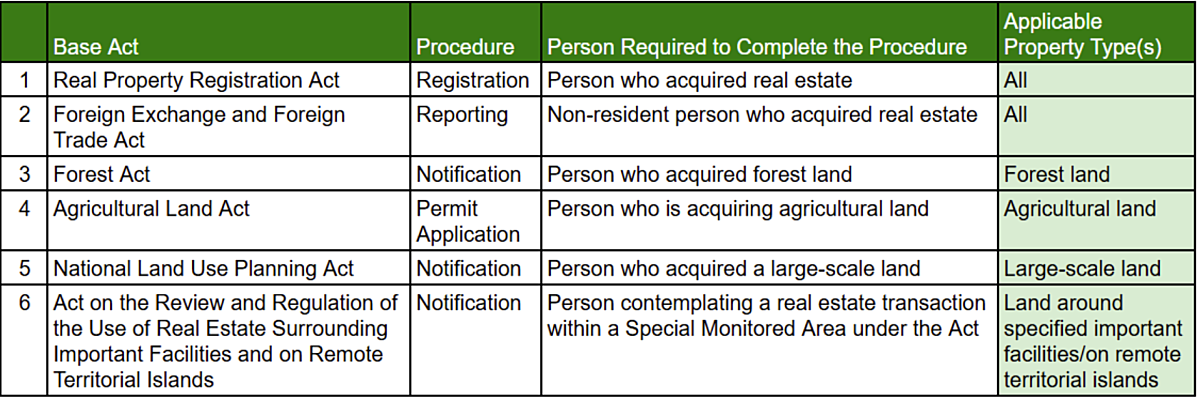
- Mandatory registration of nationality is starting in October 2026.
- Previously reporting was required for real estate acquired for investment purposes only. Reporting obligations were expanded to all types of real estate (including for residential purposes) starting in April 2026.
- New forest land owners are required to notify their nationality starting in April 2026.
- Permit applications have required the applicant’s nationality since September 2025. Starting in April 2026, applicants are also required to provide their residence status number and the expiration date of their stay.
- Individuals have been required to notify their nationality since July 2025. Starting in April 2026, corporations are also required to notify their representative’s nationality and other information.
- Individuals have been required to report their nationality since September 2022, when the Act was fully implemented. Starting in April 2026, corporations are also required to report the nationality of their representatives, and if foreigners hold a majority of the board of directors or voting rights, reporting their nationalities and other details has become mandatory.
4. What This Could Mean for Foreign Buyers
At present, foreigners can still generally purchase property in Japan without citizenship, permanent residency, or residency visas. Japan remains one of the world’s more open real estate markets in that respect.
However, the recent policy developments suggest several emerging trends:
(1) Increased Transparency Requirements
Foreign buyers and foreign-linked corporations will likely face significantly more reporting and disclosure obligations.
(2) Greater Monitoring of Sensitive Land
Land near military facilities, remote islands, forests, and water resources is likely to receive heavier scrutiny.
(3) More Oversight of Residential Purchases
Even though the government decided not to submit a bill to restrict foreign nationals purchasing condominiums for the time being, authorities may begin paying closer attention to vacant units, speculative ownership, and beneficial ownership structures again in the future.
(4) Possible Future Restrictions
Although outright bans appear unlikely in the near term, the creation of a formal expert panel indicates that the government is seriously considering whether stronger legal restrictions are necessary.
Summary
Japan is not currently moving toward a broad prohibition on foreign ownership of real estate. Instead, recent policy developments point toward greater transparency, registration, and monitoring of property ownership, particularly where national security concerns are involved.
While rising housing prices have fueled debate over foreign purchases of residential property, the government has, for now, put such restrictions on hold, concluding that measures specifically targeting foreign buyers would be difficult to implement.
Japan therefore remains one of the world's more accessible real estate markets for foreign buyers.
However, the regulatory landscape continues to evolve, with new disclosure requirements and ongoing discussions regarding important land, ownership transparency, and market stability.
Foreign buyers and investors should continue to monitor developments closely as the government considers future policy measures.
Our team of seasoned professionals at PropertyAccess is dedicated to helping you navigate Japan’s real estate market with confidence.
With deep local knowledge and a commitment to personalized service, our experts are here to guide you every step of the way.
Book a Free Consultation Session with Our Team!