Buying Japanese real estate through a company: is it better than buying as an individual?
Last Updated: September 16, 2026
Compare the tax, financing, inheritance, and legal implications of buying property in Japan as an individual or company.
Table of Contents

Supervised By: Nobuyuki Ohki
Expert in Real Estate Taxation (CPA, Tax Accountant, Real Estate Transaction Specialist)
“What is the most tax-efficient way to purchase property in Japan?”
“Buying Japanese property through a company or as an individual, which is better?”
If you are considering property in Japan, did you know buying as an individual is not the only way?
In this article, we will compare three patterns when an international investor buys real estate in Japan and explain the differences between them.
After reading the article, you will have a clear understanding of the advantages and disadvantages of buying property through a company or as an individual, so you can choose the best option that suits your situation.
Ownership Structures when Buying Japanese Real Estate:
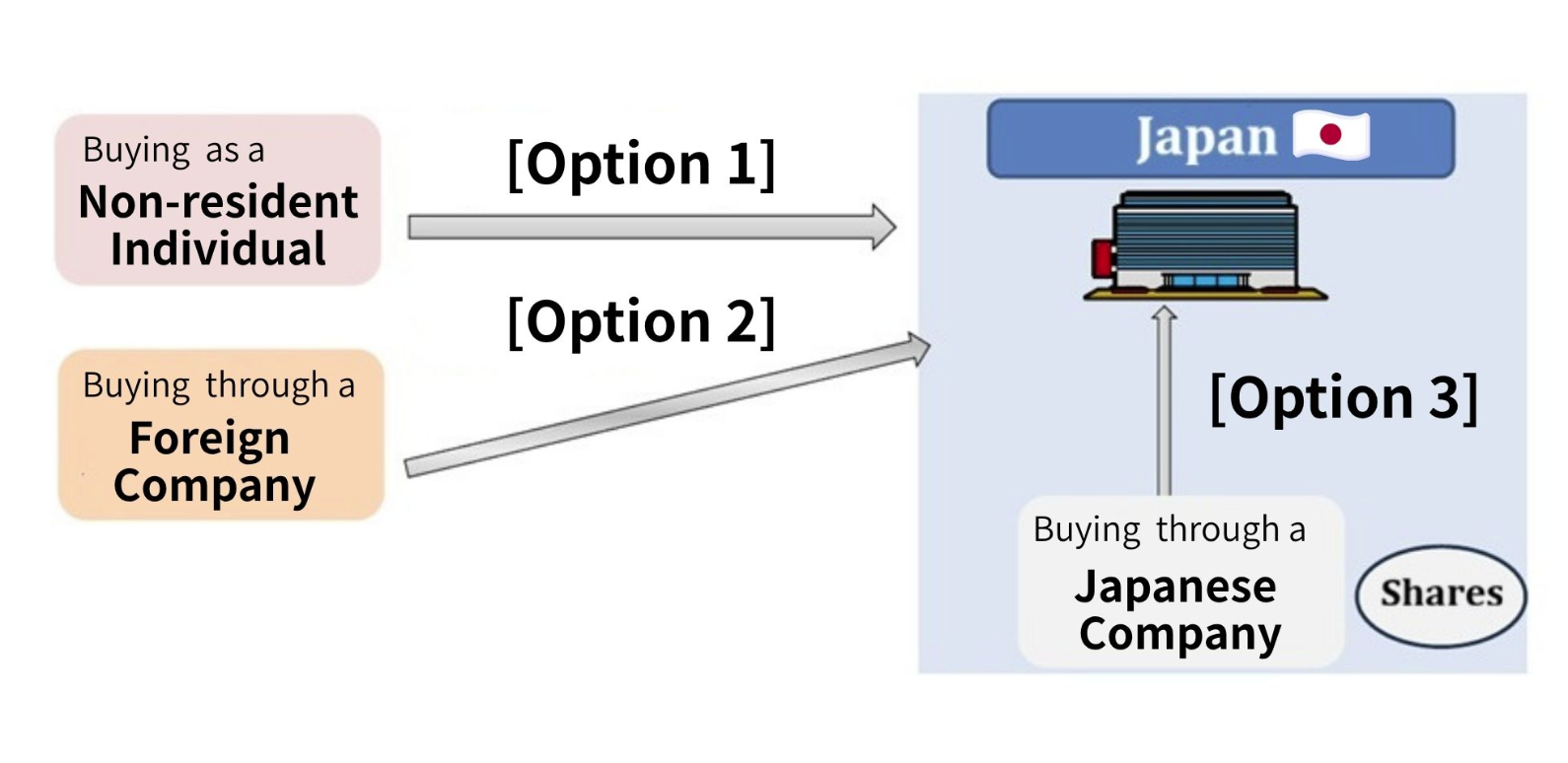
- As a non-resident individual
- Through a foreign company
- Through a Japanese company
When it comes to buying Japanese real estate as a foreigner, we can think of three options. First, you are buying the property as an individual. Second, you buy it through an off-shore company you own. You can also purchase one through a Japanese company you own, or after establishing one.
[Option 1] Buying Property as a Non-Resident Individual
Foreigners, including those who reside overseas, can generally purchase Japanese real estate with virtually no restrictions on ownership.
If your property generates income, such as rental income or capital gains, you may be subject to Japanese taxes in accordance with Japanese tax law.
(1) Income gains
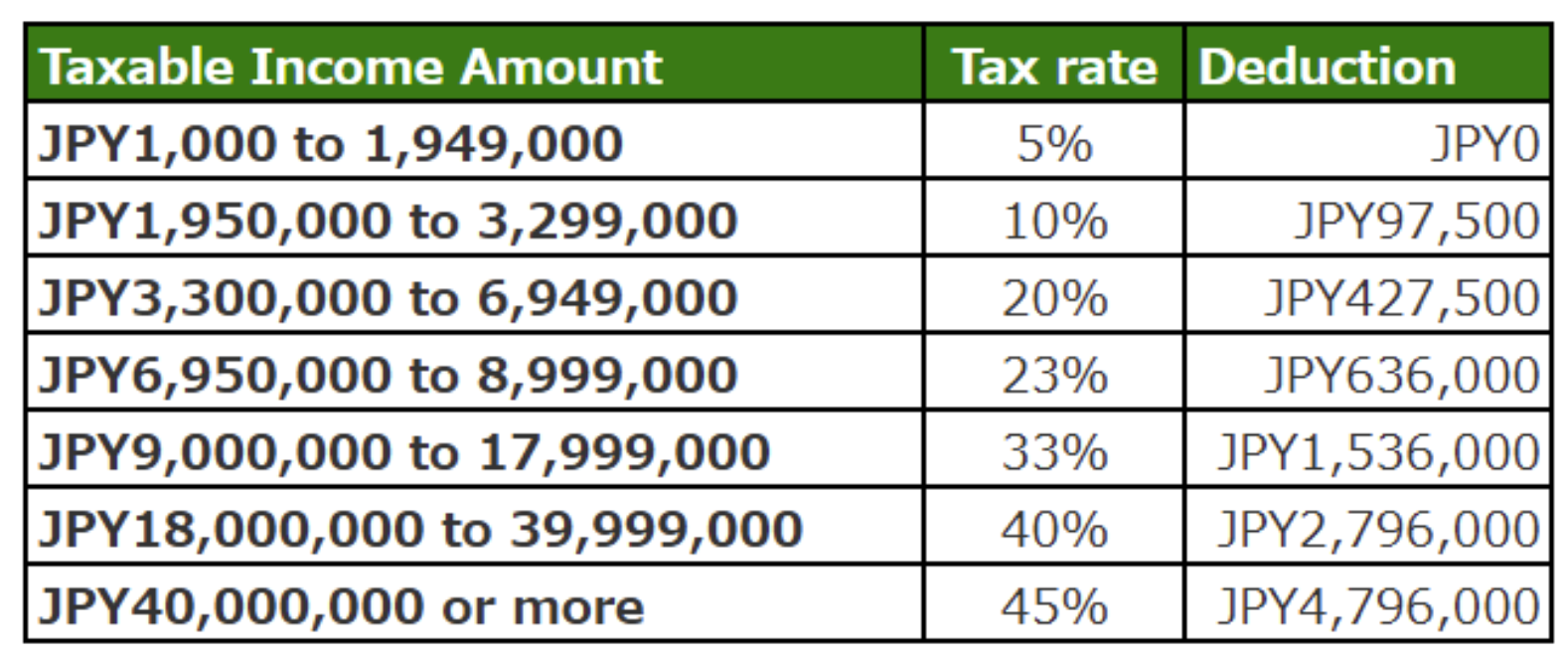
If you rent out your property and receive rental income, the rental income, together with any other Japanese-source income you earn (excluding capital gains, which are taxed separately), is subject to Japanese income tax.
Japan's national income tax for individuals is progressive, with tax rates ranging from 5% to 45%.
As a non-resident for Japanese tax purposes, you are generally not subject to Japanese resident (inhabitant) tax (10%).
(2) Capital gains
If you sell your property in Japan and realize a capital gain, the gain is subject to Japanese capital gains tax.
The applicable tax rate depends on the length of ownership, measured from the acquisition date to January 1 of the year in which the property is sold.
- If the property has been owned for more than five years, the gain is treated as a long-term capital gain and is taxed at 15.315% (15% capital gains tax plus 0.315% Special Income Tax for Reconstruction).
- If the property has been owned for five years or less, the gain is treated as a short-term capital gain and is taxed at 30.63% (30% capital gains tax plus 0.63% Special Income Tax for Reconstruction).
As a non-resident, you are generally not subject to Japanese resident (inhabitant) tax (5% for long-term capital gain, 9% for short-term capital gain).
(3) Inheritance Tax
Because the property is located in Japan, the inheritance may be subject to Japanese inheritance tax.
The taxable amount is generally determined based on the appraised value of the property for inheritance purposes, together with the value of other taxable assets, after applicable deductions.
Whether inheritance tax applies depends on the circumstances of the deceased and the heirs under Japanese tax law.
(4) Visa
Purchasing property in Japan by itself does not entitle you to a visa or residence status.
(5) Financing
Financing may be available from Japanese banks or other financial institutions.
Eligibility requirements vary by lender and typically depend on factors such as your residency status, creditworthiness, income, and other lending criteria.
[Option 2] Purchasing Property through a Foreign Company
A foreign company incorporated outside Japan may purchase Japanese real estate.
There are generally no restrictions on foreign corporate ownership of real estate in Japan.
However, the company may become subject to Japanese corporate tax obligations if it earns income from the property.
Unlike individuals, companies are taxed at corporate tax rates rather than progressive individual income tax rates.
(1) Rental Income
If an foreign company owns real estate in Japan and earns rental income, the net rental income is generally subject to Japanese corporate income tax.
The applicable tax depends on the company's taxable income and whether it has a permanent establishment (PE) in Japan.
For a company with stated capital of JPY 100 million or less, the national corporate tax rate is generally 15% on the first JPY 8 million of annual taxable income, with income exceeding that amount taxed at the ordinary corporate tax rate (approximately 23%).
If the foreign company has no permanent establishment (PE) in Japan, such as an office, branch, or other business establishment, prefectural and municipal corporate inhabitant taxes generally do not apply.
Consequently, the commonly cited effective corporate tax rate of approximately 30% to 35% generally applies only to companies with a permanent establishment in Japan.
Therefore, an foreign company without a PE is typically subject to a lower overall effective tax rate.
(Source: Corporate income tax rates, National Tax Agency, Japan)
(2) Capital Gains
If the foreign company sells the property and realizes a capital gain, the gain is generally subject to Japanese corporate income tax.
Unlike individuals, companies are not eligible for the preferential long-term capital gains tax rates.
Capital gains are treated as ordinary corporate income and taxed together with the company's other taxable income.
(3) Inheritance Tax
Since the Japanese real estate is owned by the foreign company rather than the individual shareholder, the property itself is generally not included in the shareholder's estate for Japanese inheritance tax purposes.
The death of the shareholder does not trigger Japanese inheritance tax on the underlying real estate because the property is owned by the foreign company, not the individual.
However, the transfer of shares in the foreign company may have tax implications depending on the applicable laws of Japan and the shareholder's home jurisdiction.
But in many cases where both the deceased and the heirs are non-residents with limited connections to Japan, Japanese inheritance tax may not apply to the foreign shares, although tax in the company's home jurisdiction may apply.
(4) Visa
Purchasing property through a foreign company does not, by itself, entitle the shareholder or company representatives to a Japanese visa or residence status.
(5) Financing
Obtaining financing from a Japanese financial institution may be possible but more challenging for a foreign company than for a Japanese company or an individual.
Many lenders require additional documentation, guarantees, or security, and some banks may not lend to overseas entities.

[Option 3] Purchasing Property through a Japanese Company
A company incorporated in Japan may purchase Japanese real estate regardless of the nationality or residency of its shareholders.
The company becomes the legal owner of the property and is subject to Japanese corporate laws and tax regulations.
(1) Rental Income
If the Japanese company rents out the property and receives rental income, the net rental income derived from the Japanese property is generally subject to Japanese corporate income tax.
The exact rate depends on factors such as the company's taxable income and the applicable national and local taxes, including prefectural and municipal corporate taxes.
For your reference, if the company's capital amount is less than 100 million yen and its taxable income does not exceed 8 million yen, the national corporate tax rate is generally 15% on the first 8 million yen of taxable income, with income exceeding that amount taxed at the ordinary corporate tax rate (approximately 23%).
Additionally, prefectural and municipal corporate taxes (corporate inhabitant tax, 10%) will apply.
Because a Japanese company is generally subject to both national and local corporate taxes, including resident tax and enterprise tax, the effective corporate tax rate generally ends up ranging from approximately 30% to 35%, depending on the company's size, taxable income, and location.
Japan has income tax treaties and estate tax treaties with a number of countries. These treaties may affect the taxation of rental income, capital gains, dividends, and inheritance depending on your country of residence. Investors should consider both Japanese tax law and the applicable tax treaty before deciding on an ownership structure.
(2) Capital Gains
If the company sells the property and realizes a capital gain, the gain is treated as ordinary corporate income and is subject to Japanese corporate income tax.
Unlike individuals, Japanese companies do not benefit from reduced tax rates based on the length of ownership. Capital gains are taxed in the same manner as other business income.
Capital gains are treated as ordinary corporate income and taxed together with the company's other taxable income.
In the Case of Dividend Distribution…
If the company distributes its after-tax profits to its shareholders, the shareholders may be subject to dividend taxation in accordance with the applicable tax laws of Japan and their country of residence.
Any applicable tax treaty may reduce withholding tax on dividends paid to non-resident shareholders.
(3) Inheritance Tax
Since the real estate is owned by the Japanese company, the property itself is generally not included in the shareholder's estate but shares of a Japanese company are generally treated as property located in Japan.
Therefore, Japanese inheritance tax will generally apply to those shares if they are within the scope of Japan's inheritance tax rules.
(4) Visa
Owning a Japanese company or purchasing property through a Japanese company does not automatically grant the shareholder a visa or residence status in Japan.
You may be eligible to apply for a Business Manager visa if your Japanese company actively conducts a qualifying business in Japan and satisfies the requirements under Japan's immigration laws, including those relating to business operations, office premises, and investment or scale.
However, applying for a business manager visa is becoming more difficult in recent years.
For more information about Japanese residence permit or long-term visa, also read:
🔗 Can You Get a Japanese Visa by Buying Property? The Official Answer Is No
🔗 Japan Golden Visa and Residency by Investment: What Foreign Investors Need to Know
(5) Financing
Japanese companies generally have greater access to financing from Japanese banks than overseas companies.
Lending decisions depend on factors such as the company's financial position, business purpose, profitability, available collateral, and the personal guarantees that may be required from shareholders or directors.
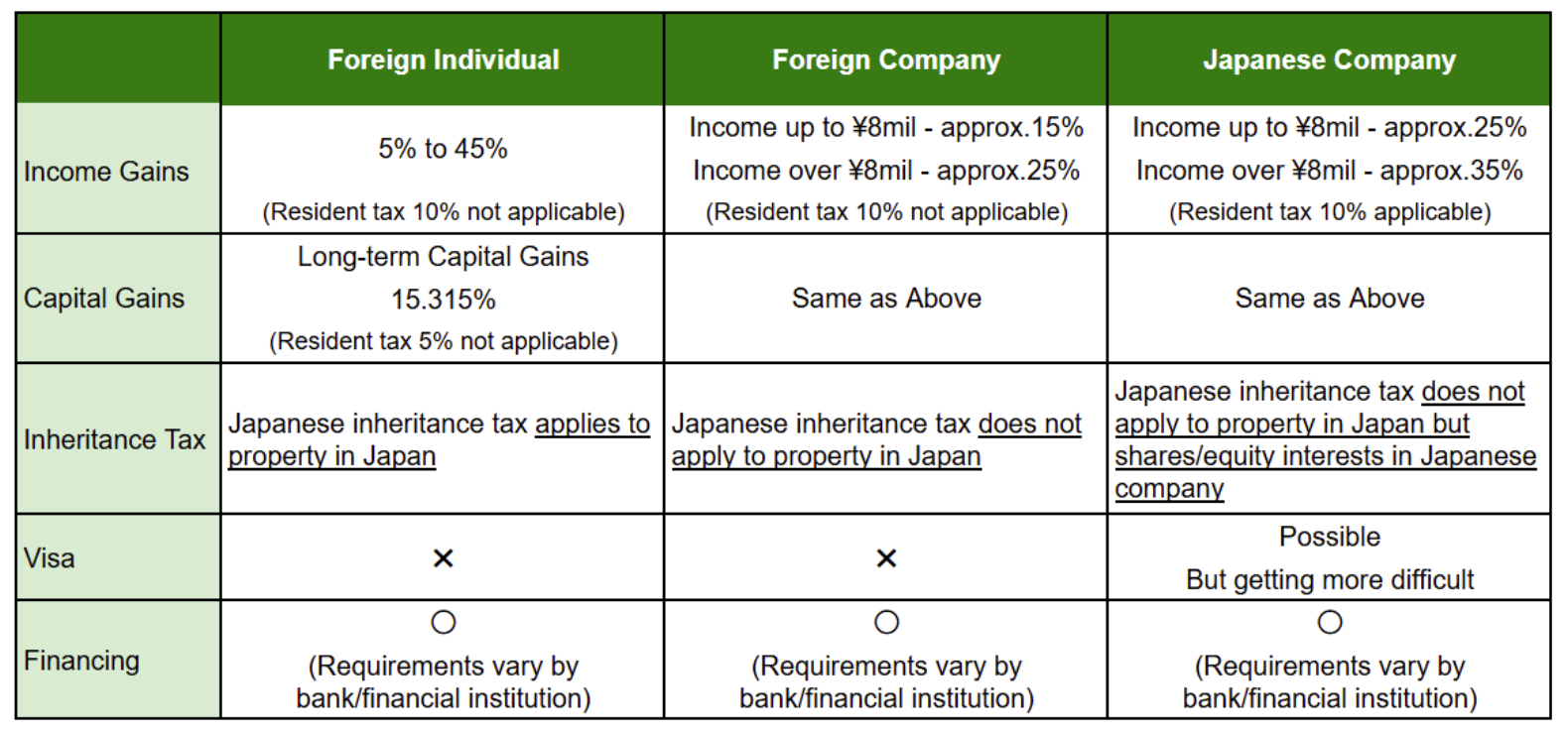
All Options at a Glance
Summary
Choosing the most tax-efficient way to purchase property in Japan depends on your investment objectives, expected holding period, financing needs, and long-term succession planning.
Buying as an individual may offer favorable tax treatment on long-term capital gains and a simpler ownership structure, while purchasing through a foreign or Japanese company can provide greater flexibility for business operations, expense deductions, and estate planning, although corporate taxation and compliance requirements are generally more complex.
Because each ownership structure has different legal, tax, and financing implications, and the optimal choice depends on both Japanese tax law and the laws of your home country, it is advisable to seek professional tax and legal advice before making an investment decision.
Our team of seasoned professionals at PropertyAccess is dedicated to helping you navigate Japan’s real estate market with confidence.
With deep local knowledge and a commitment to personalized service, our experts are here to guide you every step of the way.
Book a Free Consultation Session with Our Team!